A few weeks ago a friend sent me a small, bright-coloured booklet she picked up at a childrens' fair in Belgrade. It was called "Vukova crtanka" - Vuk's Colouring Book - and inside, between pages meant for little hands to colour in, were some of the most beloved Serbian proverbs and sayings I have ever seen collected in one place. I immediately thought of you.
Proverbs are one of my favourite ways to teach Serbian to adult learners, because they pack so much culture, rhythm, and vocabulary into a single sentence. Today we are starting at the beginning - the letters A through Dj - and I promise you will come away with at least two or three sayings that stick with you for life.
What is "Vukova crtanka"?
"Vukova crtanka" is a children's booklet of traditional Serbian proverbs, adages, tongue twisters, and riddles, illustrated in a simple, colourful style that makes it approachable for the youngest readers. The "Vuk" in the title is Vuk Stefanovic Karadzic, the great 19th-century linguist and folk literature collector who standardised the Serbian language and alphabet. His legacy lives in every proverb in this booklet - most of the sayings were recorded by him or reflect the folk wisdom he spent his life preserving.
The booklet is designed for Serbian children, but it turns out to be absolutely wonderful for adult language learners too. The sentences are short, the vocabulary is classical but accessible, and the ideas are universal. You do not need to be a native speaker to feel the weight of "Gladnog ne teši, vec nahrani."
Favourite sayings (A to Dj)
Here is a selection of the proverbs from the first half of the alphabet, each with an English gloss. Take your time with each one - say it aloud, feel the rhythm, and notice the grammar.
A
Ako je neko lud, ne budi mu drug.
- If someone is mad, do not be their friend.
("lud" = crazy/foolish; "drug" = friend, companion - a perfect rhyme in Serbian)Ako hoćeš koga da poznaš, podaj mu vlast.
- If you want to know someone, give them power.
(One of the most psychologically sharp proverbs in Serbian - still completely true today)B
Bez alata nema zanata.
- No craft without tools.
("alat" = tools/equipment; "zanat" = craft, trade - another satisfying rhyme)Bolje umeti, nego imati.
- Better to know how than to have.
("umeti" = to know how to do something; "imati" = to have - a beautiful distinction)V
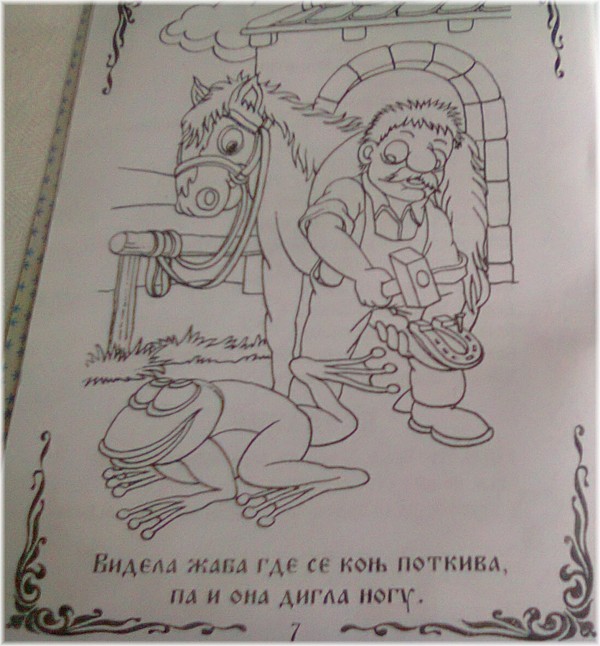
Videla žaba gde se konj potkiva, pa i ona digla nogu.
- The frog saw the horse being shod and lifted her leg too.
(Meaning: do not try to imitate those far above your station - one of the funniest images in Serbian folklore)Veselo je srce golemo blago.
- A cheerful heart is great treasure.
("veseo" = cheerful/joyful; "blago" = treasure - short, warm, and easy to memorise)G
Gladnog ne teši, vec nahrani.
- Do not comfort the hungry, feed them.
(One of the most pragmatic proverbs in any language - direct, compassionate, unforgettable)Gde je stida, tu je i poštenja.
- Where there is shame, there is honesty.
("stid" = shame/modesty; "postenje" = honesty, integrity - a subtle observation about character)D
Delo čoveka hvali.
- A man's work praises him.
("delo" = deed, work, act - related to the verb "delati," to act/work; concise and powerful)
Why proverbs stick
Proverbs are compressed wisdom - they have survived centuries precisely because every word earns its place. When you learn a Serbian proverb, you are not just learning vocabulary: you are learning the music of the language, the way it likes to rhyme at the end of a thought, the way it prefers concrete images (a frog, a horse, a hungry person) over abstract concepts. That concreteness is what makes them memorable.
Spend a week saying one proverb aloud every morning - any one from this list - and by the end of the week it will be yours for life. That is not an exaggeration; it is simply how language memory works when sound, meaning, and image come together.
Frequently asked questions
Who was Vuk Stefanovic Karadzic and why does he matter for Serbian learners?
Vuk Stefanovic Karadzic (1787-1864) is arguably the single most important figure in the history of the Serbian language. He reformed the Cyrillic alphabet to match spoken Serbian phonetically (one letter, one sound - that is his principle, and it is still in place today), collected thousands of folk songs, tales, and proverbs, and wrote the first dictionary of the Serbian vernacular. For learners, his legacy means that what you learn today is built on a beautifully logical system - and these proverbs are direct windows into the folk culture he dedicated his life to recording.
Are these proverbs still used in everyday Serbian conversation?
Most of them, yes - in varying degrees. "Gladnog ne teši, vec nahrani" and "Delo čoveka hvali" are genuinely common. "Videla žaba gde se konj potkiva" is the kind of thing a grandparent might say but a younger person would still recognise immediately and appreciate. Using a well-placed proverb in conversation is one of the fastest ways to make a native speaker smile and say, "Oh, you really know Serbian."
How do I practise proverbs effectively?
Three approaches work especially well. First, write the proverb out by hand once a day for a week - the physical act of writing helps memory. Second, try to use the proverb in a real context: if you are learning with a language partner, find a moment in conversation where it would fit. Third, look up the images: find pictures of frogs, horses being shod, old craftsmen - concrete visual associations anchor abstract language beautifully.
What does "digla nogu" mean exactly in the frog proverb?
"Digla nogu" literally means "lifted her leg" - specifically the way a horse lifts a hoof for a blacksmith to shoe it. The frog, seeing the horse doing this and not understanding why, imitates the gesture. The comedy (and the lesson) is in that gap between imitation and understanding. "Dici" means to lift or raise; "noga" means leg or foot.
Will there be a Part Two with the rest of the alphabet?
Yes - Part Two is already on its way, continuing from the letter E all the way through to Z. Some of the most interesting sayings are in the second half of the alphabet, so do not miss it. Check back soon or browse the proverbs category to find it when it is live.
I hope these sayings bring you as much delight as they brought me when I first read through this little booklet. Language at its best is also a kind of folk philosophy, and Serbian folk philosophy is wonderfully direct. Part Two is coming soon - in the meantime, pick one proverb from today's list and make it yours.
Sve najlepse,
Marina Petrovic
Want to explore more of Serbia's rich proverbial tradition? Visit the More Serbian proverbs hub for the full collection of proverb-based posts on this blog.