Personal pronouns might not be the most glamorous topic in Serbian grammar, but they are absolutely fundamental. You cannot hold a real conversation in Serbian without them - and once you know them well, you will notice just how much more natural and fluent your Serbian starts to sound. Today we dive into two of the most important cases: the Genitive and the Accusative.
Do not worry if the case names feel abstract right now. By the time you have watched the video, looked at the pronoun chart, and worked through the example sentences below, those labels will start to feel like friendly old acquaintances. Let us get started!
What does this video cover?
This video teaches the personal pronouns in the Genitive and Accusative cases. In Serbian, the same pronoun takes different forms depending on its grammatical role in the sentence. The Genitive case is used, among other things, to express possession and negation (nema je - she is not here). The Accusative case is used for the direct object of a sentence (vidim te - I see you).
These forms are used constantly in everyday Serbian, so investing time in them now pays enormous dividends later. Watch the video, practise the forms in the chart, and then try the example sentences below - ideally out loud and without looking at the translations.
Hear it
Tip: watch once to follow along, then mute and try to say the sentences while watching.
The pronoun forms
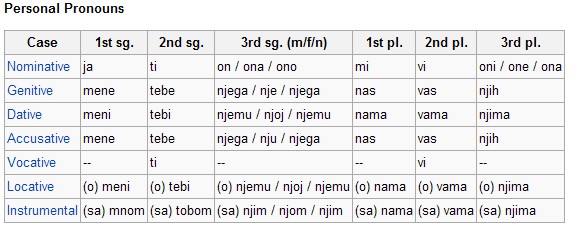
Below is a reference table summarising the key Genitive and Accusative pronoun forms covered in the video. Return to it as often as you need - these are worth knowing cold.
| Person | Nominative | Genitive (full) | Genitive (short) | Accusative (full) | Accusative (short) |
|---|---|---|---|---|---|
| 1st sg. | ja | mene | me | mene | me |
| 2nd sg. | ti | tebe | te | tebe | te |
| 3rd sg. m. | on | njega | ga | njega | ga |
| 3rd sg. f. | ona | nje | je / je | nju | je |
| 1st pl. | mi | nas | nas | nas | nas |
| 2nd pl. | vi | vas | vas | vas | vas |
| 3rd pl. | oni / one | njih | ih | njih | ih |
Note: the short (clitic) forms (me, te, ga, je, nas, vas, ih) are the ones you will hear most often in natural speech. The full forms (mene, tebe, njega) are used for emphasis or after prepositions: bez njega (without him), zbog mene (because of me).
How to practise
Here is the most effective technique for drilling these pronoun forms:
- Watch the video actively. Do not just passively observe - say each sentence aloud as it appears. Try to stay in sync with the video. This trains both recognition and production at the same time.
- Mute and shadow. Play the video again with the sound off. Now you can see the sentences (or the situations) but not hear them. Say the Serbian sentences yourself, as naturally as you can. Then turn the sound back on and compare. This is a powerful technique for building automaticity.
- Substitute and create. Take the example sentences from the video and substitute different pronouns. If the video says Vidim te (I see you), practise also saying Vidim ga (I see him), Vidim je (I see her), Vidim ih (I see them). This active manipulation is where real grammar learning happens.
More Serbian examples
Here are a rich set of sentences using the Accusative and Genitive pronoun forms in real, natural contexts. Read each one several times, then try to use them in your own sentences:
Vidim te.
I see you.
te = short Accusative of ti. This is one of the most useful sentences in Serbian.Čekam ga već dugo.
I have been waiting for him for a long time.
ga = short Accusative of on.Nema je kod kuće.
She is not at home. (lit. There is no her at home.)
je = short Genitive of ona. This construction with nema + Genitive is extremely common in Serbian.Znam ih već godinama.
I have known them for years.
ih = short Accusative/Genitive of oni/one.Volim te, mama!
I love you, mum!
Perhaps the most important sentence in any language.Bez njega ne mogu da zamislim ovaj tim.
Without him I cannot imagine this team.
njega = full Genitive of on (used after preposition bez).Poznajem je odavno.
I have known her for a long time.
je = short Accusative of ona.Zovem te sutra.
I will call you tomorrow.
te = short Accusative of ti.Zbog mene ne moraš da dolaziš.
Because of me you do not have to come.
mene = full Genitive of ja (after preposition zbog).Videli smo ih u parku.
We saw them in the park.
ih = short Accusative of oni/one.Da li me čuješ?
Can you hear me?
me = short Accusative of ja.Čekam vas kod kafea.
I am waiting for you (pl./formal) at the cafe.
vas = Accusative of vi.
The difference between Genitive and Accusative
A quick practical note, since these two cases share some pronoun forms: the Accusative answers the question "Whom/what do I see/hear/want/love?" - it marks the direct object of most verbs. The Genitive is used after certain prepositions (bez, od, do, iz, kod, zbog, za when meaning "for/of") and in negated constructions with nema. When in doubt, ask yourself: is this after a preposition, or in a nema phrase? If yes, Genitive. If it is a direct object of an action verb, Accusative. Context will guide you.
Frequently asked questions
Why do Serbian pronouns have so many different forms?
Serbian is a case language, meaning the role of a word in the sentence is shown by changing the ending of the word rather than by word order alone. Personal pronouns have up to seven different case forms, each signalling a different grammatical relationship. This might seem overwhelming, but it gives Serbian sentences great flexibility - words can be arranged in almost any order and the meaning remains clear because the case endings carry the information.
When do I use the full form vs. the short (clitic) form?
Use the short form in ordinary, unstressed positions in the sentence: Vidim te. (I see you.) Use the full form after prepositions (bez mene - without me; za njega - for him) or for emphasis: Tebe vidim, ne njega. (It is YOU I see, not him.) The short forms can never begin a sentence or follow a preposition.
Is the Accusative of "ona" "je" or "nju"?
Both exist. The short clitic form is je: Vidim je. (I see her.) The full form is nju: Gledam nju, ne tebe. (I am looking at her, not you.) After prepositions, use the full form: čekam nju - but in practice you will often hear čekam je in natural speech too. Note that je is also the third-person form of the verb biti (to be), so context is everything.
How do I remember whether a form is Genitive or Accusative?
For personal pronouns, the good news is that most Genitive and Accusative forms are identical - which means you only need to recognise the context (preposition or negation = Genitive; direct object of action verb = Accusative) rather than memorising two separate sets. The main exception is the feminine singular: Genitive nje vs. Accusative nju/je.
Are there good phrases to practise these pronouns?
Yes - use everyday conversational phrases: Vidim te svaki dan. (I see you every day.) Čekam ga. (I am waiting for him.) Da li me razumeš? (Do you understand me?) Znam ih odavno. (I have known them for a long time.) These short, complete sentences are the best building blocks.
You have covered a lot of ground today - the Genitive, the Accusative, full forms, short forms, tables and real-life sentences. That is a genuinely solid piece of Serbian grammar under your belt. Be proud of that, and keep building on it. Every sentence you construct using these pronoun forms is a tiny victory. Bravo!
- Marina Petrović
Ready to explore more Serbian pronouns and cases? Head to the More pronoun practice hub for more lessons, videos, and exercises.